Bear Market Entered!! "Chips Are Down 20%: Is It a Buy? Three Wall Street Answers, No Hype"
Wall Street's top three desks looked at the exact same numbers and gave three different answers.
Semiconductors just entered a bear market, down 20%+ from their June peak. Here's who was actually selling, the three scenarios Wall Street is split between, and what I'm personally doing about it.
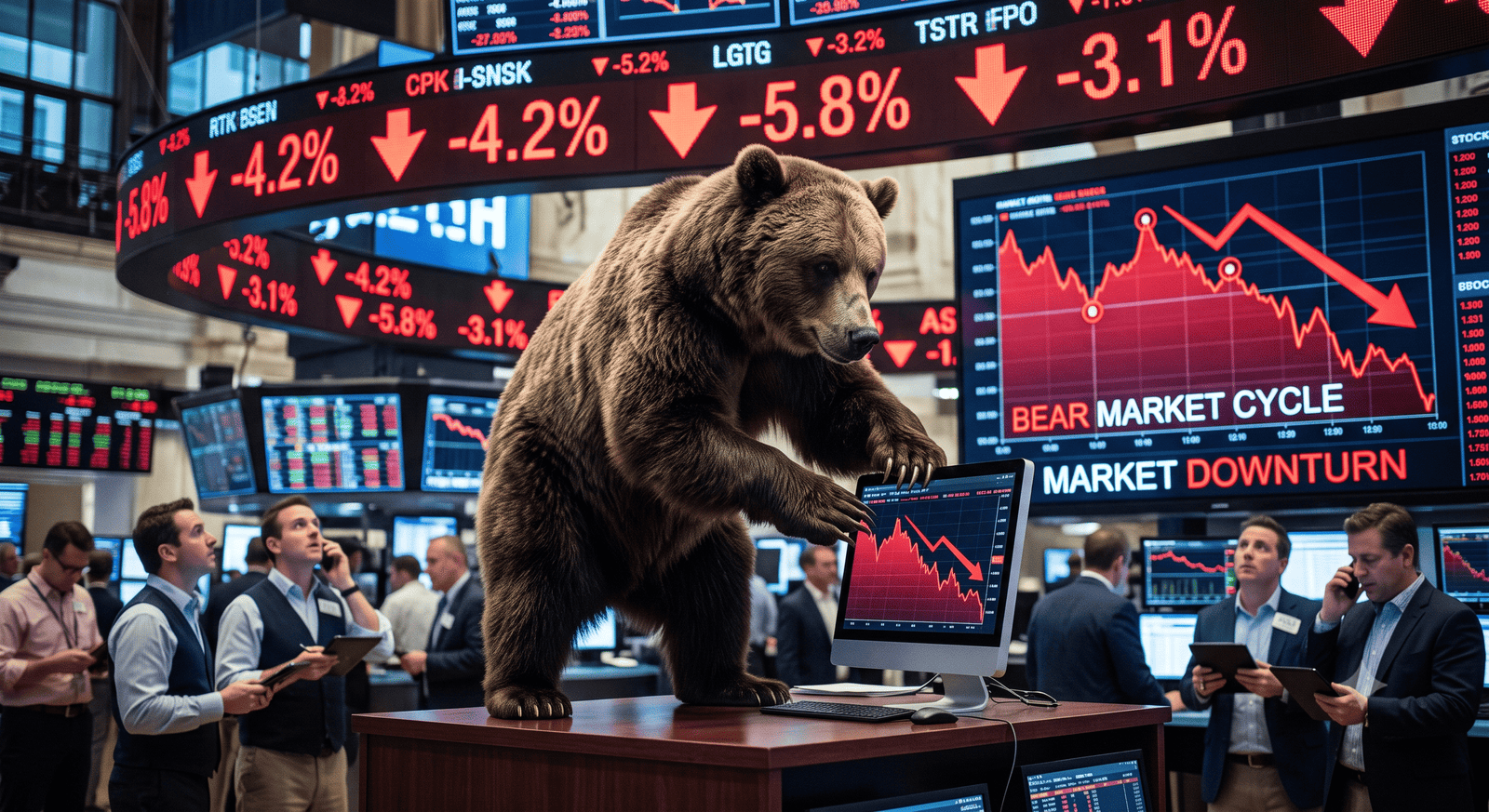
The semiconductor sector officially entered a bear market — down more than 20% from its June peak (SOXX, the iShares Semiconductor ETF, fell from around $655 to the low-$520s). Every time chips drop this hard, the same two sentences show up together: “It’s a buying opportunity.” and “Not yet.”
I felt the same itch you probably did — open the account, see red, want to average down, and somehow the finger won’t click. Turns out Wall Street was frozen in the exact same spot. Now they’ve answered — and they gave three different answers. Here’s the map.
Semiconductor stocks just entered a bear market — how it happened
No single crash. Just one brick pulled out of the wall every few days:
- A class-action lawsuit accused Samsung, SK Hynix and Micron of throttling DRAM supply to prop up prices — putting “memory prices aren’t normal” on the record.
- Cerebras got attention for building AI chips on SRAM instead of HBM — a hint that the HBM chokehold isn’t permanent.
- Meta was reported to be weighing renting out spare data-center capacity — read by the market as a whiff of over-investment.
- Raymond James and Evercore ISI both warned memory prices may be near a cycle peak. That’s the scary one: memory makers’ profits jumped mostly because prices rose. Peak price = peak profit. Not “earnings get bad” — just “earnings can’t get better.” Markets hate that even more.
- SK Hynix reportedly considered slowing HBM expansion — i.e., building less of the priciest product.
- Then a macro punch: Middle East tension pushed oil up, which revived inflation fears, which killed rate-cut hopes. The 2-year Treasury yield hit ~4.2%, its highest since February 2025. Rising rates hit long-duration “pay now, profit later” stocks first — chips sat right in the blast radius.
Korea got it worse: SK Hynix fell as much as ~43% intraday from its high — 2022-crash territory.
The part almost nobody notices: who was actually selling
Here’s the weird bit. In July, SOXX had one of its worst months in years — and yet billions flowed into the ETF the same month (around $6.1B, its biggest monthly inflow since 2018, with one single day near $5.4B). Sister fund SMH saw big inflows too.
So money’s pouring in… and the price still drops? Think of the price as the water level in a tub:
- The faucet = money flowing into ETFs. This is mostly unborrowed money — pensions, 401(k) contributions, retail. Nobody can force it to sell. When price drops, it actually flows harder, because things got cheaper.
- The drain = hedge funds, which had been pulling money out at a record pace. Goldman’s prime-brokerage desk (which sees what hedge funds trade in real time) flagged signs of capitulation — the last holders finally giving up.
And why do they give up? Not impatience — leverage. Hedge funds run on borrowed money against collateral. Price falls → collateral falls → they’re forced to sell to shrink the position. They’d love to buy the dip; the margin math won’t let them.
The drain was bigger than the faucet, so the water level dropped. But the two flows are completely different animals: one is forced, one is free.
The three Wall Street scenarios
① The bottom is already in — JP Morgan. Buyers’ money is locked in; supply can’t grow for years. Hyperscalers (Google, Microsoft, Amazon, Meta) have pledged roughly $725B to AI infrastructure — reportedly up ~77% year-over-year, and nobody’s cut. New fabs started today don’t ship until ~2028. No new supply + committed demand = little reason for prices to fall. JPM even raised its memory-market-size estimate and told clients to re-enter chips this summer. → If true: today’s screen is the cheapest you’ll see for a while.
② A bounce comes, but the leadership doesn’t — Morgan Stanley (Mike Wilson). Expect a rebound, but don’t count on chips leading the market again in the back half of the year. The AI capex cycle isn’t over, but spending has outrun revenue — and credit and CDS spreads are widening, the bond market flashing caution while stocks still party. → If true: your exit plan matters more than your entry. Ride the bounce, but decide in advance where you get off.
③ The bottom isn’t here yet — Evercore ISI. This is a mid-cycle correction, not the end of the run. Across the last 25 years, all six chip upcycles saw a correction within ~4 months of the revenue-growth peak (Evercore pegs this cycle’s peak at Q3 2026). Those corrections historically ran ~13% and ~6–7 weeks, and bottomed when chip valuations matched the S&P 500 — right now chips are still ~10% more expensive. So: maybe 2–3 more weeks and another 10–15% down (roughly SOXX $450–475). The kicker: after these corrections ended, chips historically rebounded ~36% over ~20 weeks, and the hardest-hit names led — Evercore flagged Micron, ARM, and Intel. → If true: don’t fire all your cash at once — there may be a cheaper window in a few weeks.
The thing all three agree on: none of them thinks the AI cycle is over. The fight isn’t buy vs. don’t — it’s when. And all three are staring at the same number: hyperscaler data-center spending. This earnings season (Alphabet kicks it off) settles who’s right.
⚠️ Very important to know before you touch this
This is the part I’d tell a friend, no hype:
- “Down 20%” is not the same as “cheap.” By Evercore’s yardstick, chips were still ~10% more expensive than the S&P 500 at the lows. Fell a lot ≠ good value.
- Forced selling ≠ your selling. Hedge funds sold because leverage made them. You (probably) have no margin call. Copying a forced seller with free money is a totally different decision that just looks the same.
- Money flowing in doesn’t mean up — yet. The drain can outrun the faucet for a while. But leveraged sellers eventually run out of things to sell.
- You’re not going to miss it by a day. Historical rebounds averaged ~20 weeks. This isn’t a lottery ticket you miss by sleeping in.
- Two things to actually watch: (a) the data-center capex line in Big Tech earnings — held = bullish, trimmed = the ②/③ worry gets real; (b) whether DRAM/NAND selling prices actually roll over, or it’s just talk.
- The real edge isn’t timing — it’s staying power. When someone else is forced to sell and your hand is free, the same drop is their problem and your opportunity. Only deploy money you can sit on.
My take
In my previous articles, I’ve been saying AI is still in early development and this is just a correction along the way. Even the U.S. government is backing it — they can’t afford to lose this AI race to other countries. My position hasn’t changed: wait patiently for the moment, and buy the dip on semiconductors — not all at once, just cost-average in, always.
Not financial advice — my read on someone else’s analysis plus my own, for a family software dev who trades on the side, not a professional. Semiconductor stocks can swing 10–20% in a single session; figures here reflect mid-July 2026 and change fast. Do your own homework and only risk money you can hold through the drop.
Hebojago is my journey to financial freedom, recorded live — real experiments, real numbers, wins and mistakes.
*** THE NUMBERS ***
- SOXX from June peak −20%+
- SOXX level
$655~$521 - Hyperscaler AI capex (pledged) ~$725B
- Evercore downside target $450–475
Hebojago is for information only and is not investment, tax, or legal advice. Rates and offers change — verify terms with the provider before acting.
*** GUESTBOOK / COMMENTS ***
MORE IN MARKET BRIEFING
 FIG. 26
Warren Buffett Says There's Nothing to Buy — So Why Did He Just Buy $31 Billion of Google?
The most patient investor alive is sitting on $397 billion in cash and made exactly one exception. No hype, just math.
Buffett called the market a casino and parked a record $397.4B in T-bills — then personally started a $31B Alphabet position and said not buying sooner was a mistake. Here's what those two facts mean together.
I don’t usually write about what billionaires are doing. It’s the laziest content on the internet — “Buffett bought X, so buy X” — and it’s made more people poor than rich.
But this one is different, because it’s a contradiction, and contradictions are where the actual lesson lives.
Here’s the setup. A 95-year-old man sat down with CNBC on July 15 and basically said there’s nothing worth buying in this market. His company is sitting on the biggest pile of cash it has ever held. And in the same interview, he volunteered that he personally started a $31 billion position in Google.
Both of those are true. Let’s do the math on why.
Fact 1: he really is sitting on the sidelines
Berkshire Hathaway ended Q1 2026 with $397.4 billion in cash and short-term Treasury bills — an all-time record, past the previous $381.7B high from Q3 2025. Roughly $52 billion of that is actual cash; the rest is parked in T-bills.
That detail matters more than the headline number. That money isn’t sitting in a mattress losing to inflation. It’s lending short to the U.S. government and collecting interest every single month. Which means waiting costs him almost nothing. He can say “no” for three straight years and still get paid to say it.
And he’s been saying no. In Q1 alone Berkshire sold $24.1 billion of stock and bought $16 billion — a net $8.1 billion of selling, in Greg Abel’s first quarter as CEO. Apple, once close to half the equity portfolio, is down to roughly 22% of it — still the largest holding by far, just half the weight it used to carry.
Fact 2: why he says there’s nothing to buy
Buffett’s language in the interview was blunt: it’s hard to find value when everybody around you would rather gamble. He’d used the same frame at the May shareholder meeting, describing the market as a church with a casino attached.
That metaphor is doing real work, so let me unpack it the way I’d explain it to my wife over coffee:
- The church crowd buys a business. They’re asking what this company will earn over the next ten years, and whether today’s price is cheap against that.
- The casino crowd doesn’t look at the business at all. They’re betting on whether the number goes up today.
His complaint isn’t that the casino exists. It’s that the casino got so attractive that church people keep wandering over. He singled out same-day options — contracts that settle by the closing bell — and said flatly that’s not investing and it isn’t even speculating. It’s gambling.
Here’s the mechanism that actually matters: money that only cares about today doesn’t care what a company earns in 2036. When enough of that money floods in, prices start moving independently of the underlying business. The company is the same as last year; the stock isn’t.
Run Buffett’s one ruler — is this price cheap against the next decade of earnings? — against a market priced by people who aren’t thinking about the next decade, and everything comes back expensive. Not some things. Everything. That’s how you end up with $397 billion and nothing to spend it on.
I feel this one personally, by the way. I sell cash-secured puts. I’m not going to pretend I’ve never been on the casino side of the room.
Fact 3: the one exception
Now the part that broke people’s brains.
Berkshire first showed an Alphabet position in its Q3 2025 filings, and it’s grown ever since. The stake is now north of $31 billion — behind only Apple and American Express. Less than a year in, and it’s already a top-three holding.
Everyone assumed this was Greg Abel’s fingerprint. New CEO, new era, tech bet, makes a nice story. Becky Quick asked him directly whose idea it was.
Buffett’s answer: “I initiated it.” He added that he isn’t doing anything Abel doesn’t approve of and vice versa — but that Abel is the decider going forward.
So the man who says the market is a casino personally started a $31 billion position in a company shoveling hundreds of billions into AI. That’s the contradiction. And it dissolves the second you look at when he bought.
The order of operations is the whole story
Most people only saw the $10 billion headline from June. But roughly $21 billion of that stake was accumulated before it, starting Q3 2025 — at open-market prices, no discount, no special terms. Same prices you and I could have paid.
Then in June, Alphabet announced an $84.75 billion equity raise (upsized from $80B after demand ran hot), and Berkshire took $10 billion of it as a private placement: Class A at $351.81, Class C at $348.20 — modestly below where the stock was trading.
Read that sequence again. He didn’t buy because he got a deal. He got a deal because he was already buying. The discount was a tip, not the meal.
Why Google needed the money at all
This part genuinely surprised me, so here are the numbers straight from Alphabet’s own filings and reporting:
- Operating cash flow for the year ending March 2026: about $174 billion
- Planned 2026 capital expenditures: $180–190 billion — and management says 2027 goes higher
- 2022 capex, for scale: about $31 billion
So one of the most profitable companies on earth is planning to spend more on data centers and AI chips in a single year than its entire operating cash flow. It had already issued over $85 billion of debt in the prior year. Still not enough — hence selling stock.
Issuing stock isn’t free money, by the way. There’s no interest and nothing to repay, but every new share thins out the slice existing owners hold. Same pie, more forks. Google accepted that trade anyway. That tells you how badly it wants the compute.
The 2008 comparison that changed my read
Here’s the detail that made this click for me.
When Buffett put $5 billion into Goldman Sachs during the 2008 crisis, he didn’t buy common stock. He took preferred shares paying a fat dividend, plus warrants to buy more later at a set price. He built himself an airbag. He wasn’t betting on Goldman so much as on his own terms.
This time? Plain common stock. No preferred, no warrants, no dividend guarantee — and notably, the same Alphabet raise did include mandatory convertible preferred shares, which went to public investors rather than to him.
He took the simplest, least-protected instrument available. You only do that when you think the business itself is going to be fine.
But he hedged, and the hedge is the important part
Buffett didn’t sell this as a slam dunk. Two caveats came straight out of his mouth:
One: he said he doesn’t like Alphabet as much as at least four or five other businesses Berkshire owns. That’s a ranking statement, not a rejection — he’s comparing it to wholly-owned operating businesses.
Two: on the AI arms race, he pointed out that everyone is pouring hundreds of billions in, and that’s real money.
That second one is the crux. The spending is certain. The return is not. Money leaves the account this year; whether it comes back as revenue is unknown. That asymmetry is the exact trade Buffett has spent seventy years avoiding.
So the honest summary of his position: high confidence in the company, open question on the AI math.
Now the pushback — because “Buffett bought it” is not a thesis
“His cash pile means a crash is coming.” I don’t buy it. He was at $381.6 billion back in Q3 2025 and the market went on to make new highs. Cash isn’t a prediction, it’s readiness. Treating it as a crash clock could keep you out of the market for years. [LINK — related Hebojago post on market timing]
“So I should just buy Google too.” Notice what actually happened: about two-thirds of his position was bought at ordinary market prices, like anyone could. His edge wasn’t access. It was being early and being willing. That’s not a thing you can copy after the news breaks.
“He’s not even CEO anymore.” Half true. Abel is the decider now, and Buffett said so plainly. But Buffett also said he started this one himself and that neither acts without the other’s approval.
“Buffett bought it, so it’s safe.” This is the one I want to be loud about: no. In 2011 he put about $10.7 billion into IBM — roughly 64 million shares near $170. He sold out over 2017–2018 in the $140s. Over that stretch IBM fell while the broad U.S. market roughly doubled. Someone who ignored him and bought an index fund did dramatically better. He is allowed to be wrong, and he has been, in this exact category.
The chart bit — take it lightly
The video I built this from made a technical argument I want to flag rather than assert: Alphabet had been capped by a descending trendline for months, broke above it on July 15 (the interview day) with a ~3% move, then gave it back on July 16 on Gemini-related news.
I checked directionally and the July 16 drop is real. The precise levels and moving-average claims I could not fully verify, so treat them as the video’s read, not as fact. If you care about that stuff, the only question worth asking is whether a broken level holds when it’s retested. Everything else is storytelling.
What I’m actually watching, in plain terms
Two numbers, both public, both free:
- Does Berkshire’s cash pile start shrinking? It’s disclosed every quarter. If $397.4 billion starts dropping, it means he found something. That’s a far better signal than any prediction.
- Does Alphabet’s AI spending show up as revenue? Cloud revenue growth in the quarterly report is the scoreboard. Buffett’s one reservation was that the outflow is certain and the inflow isn’t. Several quarters of that converting means his caution was misplaced. Several quarters of it not converting means it wasn’t.
The takeaway I keep coming back to isn’t about Google at all. It’s that investing isn’t a game of guessing better than everyone else. It’s a game of not buying when there’s nothing to buy, and buying when there is. A guy who held $397 billion for years and then wrote one $31 billion check is a live demonstration of both halves.
Not financial advice — I’m a software developer who writes about his own money, not an advisor. Every figure here was verified against CNBC’s July 15, 2026 interview coverage, Berkshire’s Q1 2026 disclosure, and Alphabet’s June 2026 SEC filings as of July 18, 2026, and is subject to change; anything I couldn’t confirm is labeled as unverified above. Copying a billionaire’s trade is not a strategy — his time horizon, tax situation, and downside tolerance are nothing like yours or mine.
- Berkshire cash + T-bills (Q1 2026)
$381.7B$397.4B - Berkshire's Alphabet stake $31B+
- June private placement $10B
- Alphabet 2026 AI capex plan
$31B (2022)$180–190B
 FIG. 05
Egg Recall 2026: Will Egg Prices Go Up, and Is My State Affected?
19 million eggs recalled, a Class I warning, and a $28 answer — no hype, just math.
The FDA just upgraded the 2026 egg recall to its highest risk level. Here are the brands, the codes, the states — and the honest math on what it actually does to my family's grocery bill in Seattle.
We buy eggs at Costco. Kirkland brand, two dozen, somewhere between $7 and $8 depending on the week. Our family goes through about a dozen a week, so one carton lasts us two weeks, and I honestly stopped thinking about the price after the madness of 2025.
Then on August 14, 2026, the FDA elevated the egg recall to Class I — its highest risk level, the one reserved for products that can cause serious health consequences or death — and my wife asked me the only two questions that actually matter:
Are our eggs in it? And is this going to make eggs expensive again?
So I did what I always do. I pulled the FDA and CDC filings, the USDA price reports, and a calculator. The answer to the second question surprised me, and not in the direction the headlines suggest.
First: is it your eggs?
The recall is from Midwest Poultry Services, L.P., which recalled 1,589,577 dozen shell eggs on July 22, 2026. That’s about 19 million eggs.
Quick note, because I saw this in three different places: some outlets ran with “38 million eggs.” That looks like a doubling error. 1,589,577 × 12 = 19,074,924. It’s 19 million. Bad enough without inflating it.
Brands on the recall list:
- Kroger
- Simple Truth Cage Free
- Brookshire’s
- Country Morning
- Sunups (a Cal-Maine brand)
- Plus bulk Grade A/AA foodservice packs
One clarification, because a lot of coverage muddles it: Cal-Maine did not issue this recall. Midwest Poultry Services did. Sunups is a Cal-Maine label that appears in the recalled packaging, which is a very different thing from Cal-Maine’s own farms being implicated. Cal-Maine has said as much, and it matters if you’re looking at the stock later in this post.
They came in every size you can imagine — 6, 12, 18, 24, 30, 36 and 60-egg cartons — in both white shell and brown cage-free.
The identifying codes. This is the part that actually matters, because the brand name alone doesn’t tell you anything:
- Plant code P-1950 or 0840962
- Julian date 157 through 184
- Best-by / sell-by dates July 20 through August 17, 2026
That last line is why this is still urgent as I write it. The best-by window doesn’t close until August 17. These cartons are not a historical curiosity — they can still be sitting in a refrigerator right now.
Is my state affected?
Here’s where it gets genuinely confusing, because there are two different lists and most coverage blurs them together.
Where the recalled eggs were shipped (6 confirmed states): Texas, Oklahoma, Louisiana, Arkansas, Mississippi, New Mexico. Produced at Texas farms between June 6 and July 3, 2026. The FDA notes the product may have reached additional states, so treat this as a floor, not a boundary.
Where people actually got sick (17 states): Arizona, California, Colorado, Georgia, Illinois, Louisiana, Michigan, Missouri, Mississippi, North Carolina, New Mexico, Nevada, New York, Oklahoma, South Carolina, Texas and West Virginia.
Seventeen states of illness from a six-state distribution. That gap is normal — people travel, eat out, and the eggs went to foodservice accounts too — but it’s why “my state isn’t on the distribution list” is a weaker comfort than it sounds. The FDA has also said the products “could have reached additional states.”
Washington is on neither list. Neither is Oregon, or anywhere on the West Coast except California and Nevada on the illness side.
One local wrinkle worth naming, since I live here: Kroger owns QFC and Fred Meyer, and Kroger and Simple Truth are both recalled brands. That is not the same thing as saying recalled eggs came to Seattle — the recalled lots went to Kroger stores in Texas and Louisiana. But if you see “Kroger brand eggs recalled” in a headline and shop at Fred Meyer, I understand the jolt. Check the plant code, not the logo.
The part that made me nervous
The CDC counts 98 confirmed illnesses and 26 hospitalizations, with no deaths. Illness onset runs from November 21, 2025 all the way to June 30, 2026 — this has been quietly going on for months.
But here’s the detail that got my attention as a parent: whole genome sequencing of the patient samples predicted resistance to ciprofloxacin, one of the standard antibiotics for a severe Salmonella case. That doesn’t make you more likely to get sick. It makes the bad outcome harder to treat if you’re in the small group that ends up hospitalized — older adults, very young kids, anyone immunocompromised.
Symptoms usually show up 12 to 72 hours after exposure: diarrhea, fever, stomach cramps, typically 4 to 7 days. The CDC says get medical attention for diarrhea lasting more than two days, fever above 102°F, bloody stools, or signs of dehydration.
Confession: writing this taught me I’ve been doing two things wrong
I was going to write a smug paragraph telling you to go check your carton. Then I went to check mine and realized I couldn’t.
We throw the carton away the moment we get home. Eggs get rinsed under water and go into a plastic egg tray in the fridge. It looks tidy. I’ve been doing it for years.
Both halves of that are a mistake, and I’d rather tell you myself than have you find out later.
Mistake 1: the carton is the only place the recall code lives. Plant code, Julian date, best-by date — all of it is printed on the carton, none of it is on the egg. Toss the carton and you have permanently opted out of every future egg recall. You will never be able to answer “is it mine?” The FDA’s own egg safety guidance says plainly: “Store eggs in their original carton and use them within 3 weeks for best quality.” The carton also insulates the eggs and keeps them from absorbing fridge odors. I thought I was being neat. I was destroying my own receipt.
Mistake 2: washing store-bought eggs can make them less safe, not more. US commercial eggs are already washed and sanitized at the plant, which strips the shell’s natural protective cuticle — processors replace it with a thin food-grade mineral oil coating. When I rinse that off at home, I’m removing the barrier. Worse, eggshells are porous by design, so water sitting on the shell can carry surface bacteria inward through the pores. USDA guidance is that you don’t need to wash store-bought eggs, and that washing them can increase contamination risk.
Two habits, both of which felt responsible, both of which quietly made my family less safe. This is why I write these posts with a calculator and a source list instead of from memory. T_T sad.
New rule in our house: eggs stay in the carton until they’re cracked. If the tray really matters to someone aesthetically, at least cut the code panel off the carton and tape it inside the fridge door.
And whatever else you do — cook them properly. Firm yolk and white, or 160°F for anything custardy or casserole-ish. Heat is what actually kills Salmonella. No amount of rinsing does.
Now the money question: does a 19-million-egg recall raise prices?
This is the part everyone gets wrong, including a few finance sites that should know better. Let me put on my money-blogger hat.
19 million eggs sounds enormous. It is a rounding error.
The US produced 636.8 million dozen table eggs in June 2026 alone, per USDA NASS. (Total egg production including hatching eggs was 741.6 million dozen — I’m using the table-egg number, since that’s the eggs-you-eat category the recall belongs to.) The recall is 1.59 million dozen. Run the division:
1.59 ÷ 636.8 = 0.25% of a single month’s production.
Put another way: America produces the entire recalled quantity in roughly one hour and 48 minutes.
A supply shock that lasts under two hours does not move a national grocery price. If you allocated the entire recall’s cost across US egg spending and passed it straight through to my family, it would cost us somewhere around fifty cents a year. That’s an illustrative figure, not a forecast — but it’s the right order of magnitude, and the right order of magnitude here is “pocket change.”
So no. The recall is not why your eggs might cost more.
But prices ARE moving. Here’s the actual reason.
Wholesale large eggs jumped about 35 cents to $1.09 a dozen in the week ending July 24, with large-egg inventories down 8% week over week. So something is definitely happening.
A lot of coverage hung that jump on the recall. I went and pulled the weekly USDA AMS series, and the timeline doesn’t support it:
| Week | National large loose eggs | Change |
|---|---|---|
| July 10 | — | +$0.19 |
| July 17 | $0.74 | +$0.28 |
| July 22 | ← recall announced | |
| July 24 | $1.09 | +$0.35 |
| July 31 | $1.08 | −$0.01 |
| August 7 | $0.98 | −$0.10 |
The rally started two full weeks before the recall. Prices were already climbing 19 and 28 cents a week, and Large-class inventories were already down 7% the week of July 17 — before anyone had heard of Midwest Poultry Services. The recall broke on July 22, roughly one day into the July 24 reporting week.
And then look at what happened after: prices flattened, then fell back to 98 cents by August 7. If a Class I recall of 19 million eggs were driving the market, that is not the shape the chart would make.
So what is? Bird flu. Again.
Producers have destroyed roughly 12.4 million commercial laying hens in 2026 year to date. For comparison, the entire second half of 2025 saw 5.4 million. APHIS confirmed commercial poultry detections across 12 states as of June. Every detection triggers mandatory depopulation of the whole flock, and depopulations historically show up at retail six to eight weeks later.
Unlike a recall, that’s a real supply loss. A recalled egg was already laid. A culled hen doesn’t lay tomorrow, or for the 18 months it takes to raise her replacement to laying age.
The USDA agrees. In its August 14, 2026 outlook, it raised its 2026 egg price forecast to 110.6 cents per dozen, up from 96.8 cents a month earlier. That’s a 14% upward revision in a single month — a big move for a government forecast. It also nudged first-half 2027 up to 111 cents from 108, and trimmed 2026 production to 9,109 million dozen.
The context nobody puts in the headline
Here’s the part that should calm you down: eggs are still dramatically cheaper than a year ago.
The USDA’s national wholesale index for large caged eggs on August 3, 2026 was 105.31¢. One year earlier: 285.55¢. Retail told the same story — the BLS average for a dozen Grade A large eggs was $2.19 in July 2026, down roughly 35% year over year. USDA still projects 2026 finishing about 30% below 2025 overall.
So the honest framing is not “eggs are spiking.” It’s “eggs crashed from an insane peak, spiked briefly in July, eased again in early August, and are expected to run modestly higher into next year from a very low base.”
Less exciting. More true.
What this actually costs my family
Enough theory. Real numbers, my actual grocery habit.
We pay about $7.50 for two dozen Kirkland eggs at Costco (call it the midpoint of $7–$8). We eat about a dozen a week, so 52 dozen a year — 26 cartons.
That’s 31 cents an egg, and about $195 a year on eggs.
A three-egg scramble costs me 94 cents.
Now let’s stress-test it. If the USDA’s 14% upward revision passed through to retail completely and immediately — which it never does, retail is stickier and Costco is stickier still — here’s the damage:
| Scenario | Per dozen | Per egg | 3-egg scramble | Our yearly egg bill |
|---|---|---|---|---|
| Today ($7.50 / 2 dozen) | $3.75 | 31¢ | 94¢ | $195 |
| USDA’s new forecast (+14%) | $4.28 | 36¢ | $1.07 | $223 |
| My own 2025 peak ($10 / 2 dozen) | $5.00 | 42¢ | $1.25 | $260 |
| The all-time national record (Mar 2025) | $6.23 | 52¢ | $1.56 | $324 |
The USDA scenario costs my family $28 a year. Fifty-four cents a week. Thirteen cents per scramble.
The nightmare scenario — a complete replay of what I personally paid at the worst of 2025 — costs us $65 a year. A dollar twenty-five a week.
And that bottom row is the true worst case in recorded American history. The BLS monthly national average for a dozen Grade A large eggs peaked at $6.23 in March 2025, and the daily national average touched an unbelievable $8.15 on March 4, 2025. If that exact peak had held for a full year, our egg bill would go from $195 to $324 — $129 more, or $2.48 a week.
Two side notes worth pulling out of that table.
First: even at the peak, my Costco price of $5.00 a dozen was running about 20% below the national average of $6.23. Buying the bigger pack at a warehouse store did more for me during the crisis than any strategy I could have layered on top.
Second, and this is the part I want to sit on: the worst egg crisis in modern American history — a year of headlines, a DOJ antitrust inquiry, genuine political fallout — would have cost a family eating a dozen a week about $129 over twelve months. Roughly one restaurant dinner.
That is not me saying it doesn’t matter. For a family eating four dozen a week on a tight budget, that $129 becomes $516, and that is very real money. But it explains why I’m not reorganizing my finances over an egg headline. Eggs are the most visible price in the grocery store — a single item, bought weekly, with a number you can’t help but memorize. Visibility isn’t the same as impact. The line on my budget that actually deserves this much attention is the mortgage, and it isn’t close.
Should I stockpile? (I wanted to. I can’t.)
My instinct was to grab an extra carton on the next Costco run. Buy at 31 cents an egg, laugh at 36 cents in October. Easy win.
Then I opened my refrigerator.
We don’t have the space. Two adults, young kids, a Costco-sized everything already fighting for shelf real estate. There is no world in which four dozen eggs live in my fridge. So I’m buying one carton, same as always.
Which is honestly the right answer anyway, and here’s the math that proves it. Eggs keep about 3 to 5 weeks refrigerated. Say I successfully stockpiled an extra month’s worth — four dozen, $15 — right before a 14% increase. I’d save 14% of $15, or $2.14. Once.
Two dollars and fourteen cents, in exchange for a jammed refrigerator, elevated spoilage risk, and the mental overhead of tracking best-by dates. And that’s the best case, where I correctly time a price move that professional commodity traders can’t reliably time.
The stockpiling play is not worth it at this scale. Not because it doesn’t work, but because eggs are too cheap for the win to matter. Sometimes the honest answer to “how do I optimize this” is “this isn’t worth optimizing.” There’s always a catch, and here the catch is that the prize is two bucks.
My fridge being too small saved me from a bad idea. I’ll take it.
If you want to actually reduce this line item: buy the larger Costco pack, don’t waste them (Americans throw out a shocking share of the eggs they buy), and if you order groceries online, run it through a card with a grocery bonus. My Sapphire Preferred earns 3x on online groceries — my in-store Costco run doesn’t qualify, so I’m not going to pretend it’s saving me anything here. But if delivery is how you shop, that one’s worth a look.
Which stocks get hit?
Now the part I find most interesting, because the market’s reaction was the exact opposite of what the headlines would predict.
On Friday, July 24 — the day the CDC and FDA announced the outbreak link — the egg-linked stocks went UP.
- Cal-Maine Foods (CALM) — the recalled Sunups brand is its label — closed $90.32, up 2.5%
- Kroger (KR) — the clearest retail link, via Kroger and Simple Truth labels — closed $56.87, up 2.0%
- Vital Farms (VITL) — no exposure to this recall whatsoever — closed $13.02, up 2.2%
(On July 22, the actual recall announcement day, CALM rose a barely-there 0.7% to $87.86. The market’s shrug was immediate.)
Why? Because traders ran the same division I did above. The recall is 0.25% of a month’s supply — for Cal-Maine specifically, the affected volume is roughly 0.13% of its annual shell-egg sales of about 1.2 billion dozen. Meanwhile wholesale prices were climbing hard. The market looked straight past the recall and priced the eggs. For a producer, an egg-price increase is revenue.
That’s the counterintuitive lesson worth keeping: a recall is a headline risk; a supply shortage is an earnings event. They can point in opposite directions, and the market usually cares about the second one.
Where they sit today
Checked on August 14, 2026, the day of the Class I upgrade:
| Ticker | Company | Price | Day change |
|---|---|---|---|
| CALM | Cal-Maine Foods | $81.09 | −1.8% |
| KR | Kroger | $56.69 | −0.9% |
| VITL | Vital Farms | $10.90 | −6.0% |
| POST | Post Holdings | $80.95 | +0.5% |
| SFM | Sprouts Farmers Market | $82.50 | −0.2% |
| TSN | Tyson Foods | $58.17 | +3.2% |
Mostly red. Worth noting that CALM has given back most of its year: it was up about 5% YTD in late July, and after today’s slide it’s hovering near roughly flat for 2026 — it also posted a surprise quarterly loss in July, which matters a lot more to that stock than any recall. Verify every quote here before acting on it; they’ll be stale by the time you read this.
For context on the sector, 2026 has been a brutal year for food-safety headlines generally — Chipotle dropped 9% on a jalapeño-linked salmonella investigation (a separate outbreak, 345 illnesses across 27 states, which several outlets have confusingly mixed into egg-recall coverage), and Taco Bell pulled shredded lettuce nationwide over a cyclosporiasis outbreak.
How I’d actually think about it
Cal-Maine (CALM) is the pure play, and it’s a genuinely strange asset. It’s a commodity producer whose earnings swing violently with egg prices, which in turn swing with a bird virus nobody can forecast. It printed extraordinary profits during the 2025 crisis and a surprise quarterly loss in July 2026 — same company, about a year and a half apart. It is not a quiet compounder. It’s a bet on avian influenza severity, whether you frame it that way or not. It also carries legal overhang from the post-2025 price scrutiny: on June 29, 2026 it settled with the DOJ and 17 state attorneys general over alleged egg-price antitrust claims for $1.5 million, plus a commitment to donate 30 million eggs.
Kroger (KR) carries the brand and liability exposure, but eggs are a rounding error against a company this size. The recall is a headline, not a thesis.
Vital Farms (VITL) had nothing to do with this recall and is down about 6% intraday today anyway. That’s the sympathy-move risk in this sector: the whole shelf gets repriced when one carton makes the news, whether or not the carton was yours.
The honest position: I’m not doing anything. Not because there’s no trade here, but because “buy an egg producer because a bird virus might get worse” requires me to forecast avian influenza, and I can’t. Neither can the USDA — that’s why they just revised their own forecast 14% in one month.
What I am doing is watching USDA’s weekly layer-flock depopulation numbers rather than recall headlines. Depopulations lead retail prices by six to eight weeks. If culls accelerate into fall — and fall is when wild-bird migration historically drives detections up — that’s the actual signal, and it will show up in the data long before it shows up in my Costco receipt.
What I’d do this week
- Check your carton codes — P-1950 or 0840962, Julian 157–184, best-by July 20–Aug 17. Best-by dates run through Monday, so this is live right now.
- If they match, don’t taste-test them. Salmonella doesn’t change how an egg looks or smells. Throw them out or return them for a refund, then wash the shelf and any container they touched with hot soapy water.
- Keep the carton from now on. Costs nothing. It’s your only proof of identity in the next recall.
- Don’t rinse store-bought eggs, and cook them until firm.
- Don’t panic-buy. The recall isn’t a supply event, and the real driver — bird flu — moves on a six-to-eight-week lag you’ll have plenty of warning about.
- If you’re watching the tickers, watch flock depopulation data, not recall headlines. The 2026 chart already told us which one the market cares about.
The bottom line
A 19-million-egg Class I recall is a serious food safety story — antibiotic-resistant strain, 26 people hospitalized, cartons still in fridges this weekend. Take that part seriously and go check your codes.
As a money story, it’s noise. The recall is 0.25% of one month’s supply — under two hours of national output, and the wholesale rally that got blamed on it started two weeks before it happened. What actually moves your egg bill is 12.4 million dead hens. And even a full replay of March 2025, the most expensive month for eggs in recorded American history, would cost my family $129 over a year.
Check your carton codes. Keep the carton. Don’t rinse them. Cook them until firm.
Then go worry about a line on your budget that costs more than one dinner out.
Recall details verified against FDA and CDC filings on August 14, 2026. This is an active investigation — codes, brands and affected states can expand, so confirm current status on FDA.gov before relying on anything here. Price figures come from USDA NASS, USDA AMS and BLS as of the dates cited; egg markets move weekly and these will age fast. The July 24 AMS weekly figure is secondary-sourced. Stock prices in the “where they sit today” table are intraday on August 14, 2026. The cost scenarios are illustrative arithmetic built on USDA’s own published forecast revision — they are not predictions, and nobody can forecast bird flu, the USDA included (they just revised themselves 14% in a month). I hold no position in any stock mentioned and this is not a recommendation to buy or sell anything. I’m a software developer who writes about my own money, not a financial advisor or a doctor, and nothing here is financial or medical advice. If you think you have a Salmonella infection, call a doctor, not a blogger.
- Eggs recalled 19 million
- Share of one month's US supply 0.25%
- My cost per 3-egg scramble 94¢
- If USDA's new forecast lands
94¢$1.07 - Extra cost to my family, per year $28